Vagus Nerve Stimulation for Longevity and Living More
Discover how vagus nerve stimulation (taVNS) supports longevity by improving sleep, stress resilience, exercise recovery, metabolism, and social connection.
Last updated:
By Dr. Jane XIAO · Vagus nerve stimulation technology for better sleep and less stressPublished · 11 min read
Slow breathing in nature: a simple daily vagus nerve practice to support living more and longer.
Living More: A Different Way to Think About Longevity
Ninety years ago, it was the vagus nerve that changed everything in neuroscience. In 1921, Otto Loewi stimulated the vagus nerve of a frog heart and discovered that nerve signals also travel through chemical messengers (Loewi, 1936). He named the substance Vagusstoff, later identified as acetylcholine, and received the Nobel Prize in 1936. Through one experiment on the vagus nerve, neuroscience gained one of its most important insights.
Today, scientists focus more and more on the central nervous system and its role in longevity. But the vagus nerve, as the most important nerve of the autonomic nervous system, deserves equal attention (Butt et al., 2020). It connects to every organ involved in how we sleep, manage stress, recover from exercise, digest food, and relate to self and others. Learning to regulate it may be one of the most direct and underused tools for living more.
Living more is the real goal of longevity science. Not simply more years, but more of what makes those years worth having.
In his book The 4 Pillar Plan, British physician Dr Rangan Chatterjee proposed that everyday health rests on four foundations: relaxation, food, movement, and sleep (Chatterjee, 2017). His core point was simple. You do not need to be perfect at any one of them. What matters is keeping a healthy balance across all four, because they are too closely linked to work on in isolation.
This framework has resonated because it is concrete. It names the exact daily areas where biology responds to behaviour. The present framework builds on this by adding a fifth pillar, connection, as a domain with its own strong influence on healthy ageing. Connection includes the quality of relationship with oneself, with others, and with the wider world.
What does more look like across these five pillars? In sleep, it means good sleep quality and waking up genuinely restored. In stress, it means feeling calm and joy without effort. In movement, it means a body that still works well with physical independence. In nutrition and metabolism, it means a healthy digestive system. In connection, it means still stay mentally and emotionally engaged with the world, including self, others, nature etc.
For most of human history, these qualities simply declined with age. The common assumption was that time erodes them. But longevity research increasingly shows this erosion is not inevitable. It is largely biological, driven by specific processes that can be measured and influenced (Thayer & Lane, 2009). People who age well across all these areas share a recognisable pattern in their physiology. One of the most consistent signals is a well-regulated autonomic nervous system, and at the centre of that system sits one nerve that is often overlooked.
The Vagus Nerve: The Brain's Window into the Body
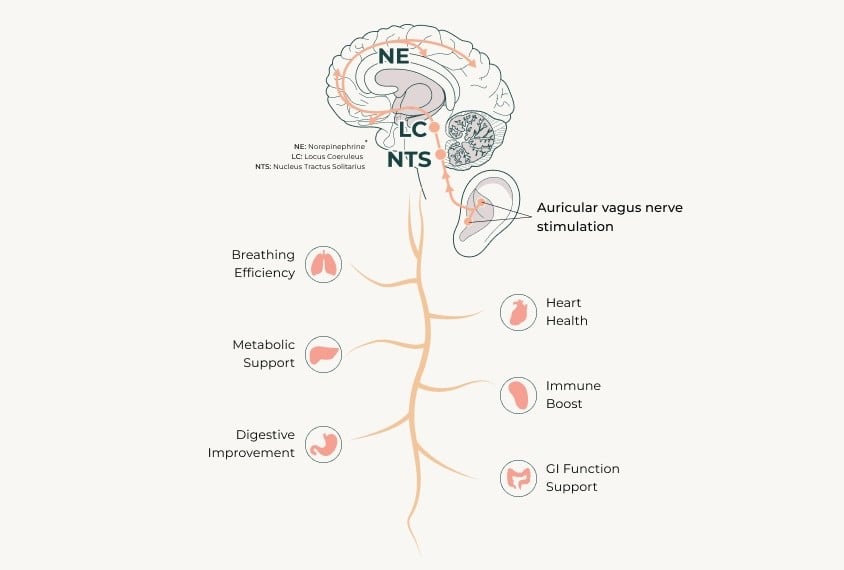
The vagus nerve is responsible for rest, recovery, and repair. It is the longest cranial nerve in the human body. It starts in the brainstem and branches down through the neck, chest, and abdomen, connecting to the heart, lungs, gut, liver, and spleen (Butt et al., 2020). It forms the structural backbone of the parasympathetic nervous system.
What makes the vagus nerve special is the direction it carries most of its signals. About 80% of its fibres are afferent, meaning they carry information from the body up to the brain. The vagus nerve is the brain's main window into the body's internal state.
When the vagus nerve works well, the brain receives clear, continuous signals about heart rhythm, breathing, digestion, and immune activity. It can then respond with precise adjustments across every system that supports body and mind.
Vagal health is most often measured through heart rate variability (HRV), the small changes in time between heartbeats. Higher HRV reflects a more responsive parasympathetic system (Thayer & Lane, 2009). It is linked to better emotional regulation, healthier digestion, lower inflammation, and greater stress resilience.
Chronic low-grade inflammation, now called inflammaging, is one of the core biological drivers of ageing. It shows up as stiff joints, slower thinking, and blunted mood. The vagus nerve fights this through three pathways to suppress pro-inflammatory proteins and increase anti-inflammatory proteins (Pavlov & Tracey, 2012). A healthy vagus nerve does anti-ageing work every day at the cellular level.
taVNS: A Non-Invasive Way to Support Vagal Health
Transcutaneous auricular vagus nerve stimulation, or taVNS, activates the vagus nerve through mild electrical pulses to the outer ear. The stimulation is placed at the cymba conchae, cavum conchae, or tragus, where the auricular branch of the vagus nerve sits close to the skin (Butt et al., 2020).
The signal of taVNS travels to the brainstem and spreads across brain regions involved in mood, sleep, autonomic regulation, and cognition.
Unlike surgically implanted stimulators, taVNS needs no procedure. Side effects are minimal, with the most common being brief, mild discomfort at the electrode (de Oliveira et al., 2025). Several devices are now built for home use. This matters. A longevity tool that does not fit into daily life will not be used.
What follows reviews the growing research on taVNS across the five pillars of daily wellness.
Five Pillars: Where Vagal Health Meets Living More
Living more is not built in one big step. It grows through the daily quality of five linked habits: sleep, stress management, exercise, nutrition, and connection. Each one shapes a different part of what more means. And each one is regulated, in part, by the vagus nerve.
Pillar One: Sleep
Sleep is one of the most direct routes to more. During sleep, the brain stores memories, removes waste, and repairs the neural connections that support thinking and emotional balance the next day (de Oliveira et al., 2025). Poor sleep over time does not just cause tiredness. It speeds up cellular ageing, disrupts metabolism, and reduces the sharpness and steadiness that make life feel full.
The vagus nerve plays a direct role in sleep. Strong parasympathetic tone reduces the mental overactivity that causes insomnia and helps the brain transition into deep, restorative sleep.
A 2025 systematic review in Neuromodulation, covering six studies and 336 patients, found that taVNS produced significant improvements in sleep quality (de Oliveira et al., 2025). Gains were seen in sleep latency, duration, efficiency, and daytime function.
Pillar Two: Stress
Long-term psychological stress is one of the best-documented drivers of faster biological ageing. High cortisol over time shortens telomeres and weakens immune function. It also narrows the emotional and mental bandwidth that makes life feel rich (Jackowska et al., 2025). Stress does not just shorten years. It empties them.
The vagus nerve is the body's main recovery system after stress. High vagal tone helps the parasympathetic nervous system take over more quickly after a stressful event. The body returns to baseline instead of staying locked in alert mode.
A 2025 randomised trial in Biological Psychology, with 70 community-dwelling adults tested 14 days of daily taVNS against sham. Active taVNS was significantly better than sham for anxiety and perceived stress. The authors noted this was among the first evidence that taVNS could be used at scale to reduce stress vulnerability (Jackowska et al., 2025).
A separate meta-analysis of 12 randomised trials covering 838 patients found that taVNS significantly reduced depression and anxiety scores. The result is not numbness but greater emotional range: the ability to feel fully without being overwhelmed (Tan et al., 2023).
Pillar Three: Exercise
Physical capacity is one of the most tangible expressions of more. Being able to move freely, lift things, climb stairs, and wake without pain: these are not abstract health metrics. They are the fabric of a life that feels full. Regular exercise is the most well-supported intervention for extending healthy years (Jandackova & Jarczok, 2019).
The vagus nerve is central to how the body adapts to training. High vagal tone is linked to faster recovery after effort. It relates to lower resting heart rate, and greater cardiovascular efficiency. These are not just athletic markers. They reflect long-term heart health.
A 2026 study in Scientific Reports found that 20 minutes of taVNS after exercise significantly sped up parasympathetic recovery and produced a much greater drop in blood lactate and perceived fatigue compared to sham (Trissolini et al., 2026).
A parallel study found that taVNS during a cardiac stress test lowered heart rate at peak effort. For people exercising to stay strong and capable across decades, taVNS shows real potential as a recovery support tool (Saverino et al., 2025).
Pillar Four: Nutrition and Metabolism
The vagus nerve's relationship with food goes deeper than appetite. Hunger and fullness signals start in the stomach wall, which send signals up through vagal fibres to the brainstem. The brain then combines these with hormonal and metabolic inputs to regulate appetite, food choices, and digestive rhythm.
When this system works well, eating becomes responsive to actual body signals rather than driven by habit, stress, or a blunted sense of fullness. This is a form of metabolic more: better sensitivity to internal state, fewer poor food choices, and less of the slow metabolic drift that builds into disease over time.
A 2024 study in Psychophysiology found that active taVNS, compared to sham, significantly reduced food preference scores during the fullness phase of a gastric protocol (Salaris & Azevedo, 2024). The proposed mechanism is stronger stomach-brain coupling: taVNS appears to boost the vagal signal from stomach sensors, making fullness more salient in the brain and reducing the drive to eat beyond need. The same study noted that taVNS also increases gastric motility and normalises digestive rhythm.
Pillar Five: Connection
Of all the variables in longevity research, connection is the most wide-ranging. It includes relationships with other people, community, animals, and nature.
It also includes something quieter: the quality of connection with oneself. Both matter. And the vagus nerve is central to both.
Connection with others
Strong social ties are among the most powerful predictors of healthy ageing. A 2025 study in Brain, Behavior and Immunity — Health, drawing on data from 2,117 adults in the MIDUS longitudinal study, found that richer social ties across family, community, and friendship was linked to slower epigenetic ageing and lower inflammation levels. Connection is not a soft variable (Ong et al., 2025).
Based on polyvagal theory, the ventral vagal pathway forms what researchers call the social engagement system. It is the neural basis for facial expression, tone of voice, eye contact, and active listening. When vagal tone is high, people connect with others more naturally, read social cues more accurately, and manage their emotional reactions more easily (Porges, 2007).
By calming the amygdala and modulating the prefrontal cortex, taVNS reduces the threat-reactivity that can make social engagement feel tiring or unsafe (Tan et al., 2023; Jackowska et al., 2025).
Connection with oneself: interoception
The brain listens to the body through vagus nerve. Before anyone can make choices that match their actual physical state, they need to hear what the body is saying.
This capacity is called interoception: the ability to sense internal signals like heartbeat, breathing, and gut activity.
A 2024 study in Human Brain Mapping, 53 participants completed a heartbeat counting task and brain data recordings under both active taVNS and sham stimulation, one week apart. They found that taVNS helped the brain read the body more precisely through both behavior and brain data (Ventura-Bort & Weymar, 2024).
Better interoception means more accurate emotional awareness, better self-regulation, and more responsive bodily control.
The Vagus Nerve as a Lever Worth Pulling
The vagus nerve is the nerve through which we know ourselves. The clearer that signal, the better the body can regulate sleep, manage stress, recover from effort, make sense of hunger and fullness, and stay open to connection.
Non-invasive taVNS is one direct way to support this system. But it is not the only one. Slow diaphragmatic breathing, cold water exposure, aerobic exercise, humming and singing, and practices that engage the social engagement system all activate vagal pathways and build vagal tone over time. These approaches work together, not in competition. They are different entry points into the same underlying system.
Across five pillars, a growing body of research points to a shared thread running through the biology of ageing: the gradual erosion of sleep quality, stress resilience, physical capacity, metabolic sensitivity, and connection. The vagus nerve runs through all of it. The evidence reviewed here supports vagus nerve stimulation (taVNS) as a meaningful form of preventive care for longevity, not a targeted fix for a single problem, but a whole-system investment in the biological foundation of living more.
Ninety years ago, one experiment on the vagus nerve changed how we understood the entire nervous system. The field is still uncovering what this nerve does. As research expands and as more people incorporate vagal regulation into daily life, the vagus nerve may yet reveal its contribution to some of the most important conditions of ageing: neurodegeneration, metabolic disease, chronic inflammation, and cardiovascular decline. The potential is there. The work of unlocking it has only just begun.
Further sources
Butt, M. F., Albusoda, A., Farmer, A. D., & Aziz, Q. (2020). The anatomical basis for transcutaneous auricular vagus nerve stimulation. Journal of Anatomy, 236(4), 588–611. https://doi.org/10.1111/joa.13122
Chatterjee, R. (2017). The 4 pillar plan: How to relax, eat, move and sleep your way to a longer, healthier life. Penguin Life.
de Oliveira, H. M., Gallo Ruelas, M., Viana Diaz, C. A., Oliveira de Paula, G., Fruett da Costa, P. R., & Pilitsis, J. G. (2025). Transcutaneous auricular vagus nerve stimulation in insomnia: A systematic review and meta-analysis. Neuromodulation, Advance online publication. https://doi.org/10.1016/j.neurom.2025.04.001
Jackowska, M., Koenig, J., Cibulcova, V., & Jandackova, V. K. (2025). Effects of transcutaneous vagus nerve stimulation on subthreshold affective symptoms and perceived stress: Findings from a single-blinded randomized trial in community-dwelling adults. Biological Psychology, 202, Article 109169. https://doi.org/10.1016/j.biopsycho.2025.109169
Ong, A. D., Mann, F. D., & Kubzansky, L. D. (2025). Cumulative social advantage is associated with slower epigenetic aging and lower systemic inflammation. Brain, Behavior and Immunity — Health, 48, Article 101096. https://doi.org/10.1016/j.bbih.2025.101096
Pavlov, V. A., & Tracey, K. J. (2012). The vagus nerve and the inflammatory reflex: Linking immunity and metabolism. Nature Reviews Endocrinology, 8(12), 743–754. https://doi.org/10.1038/nrendo.2012.189
Salaris, A., & Azevedo, R. T. (2024). Investigating the modulation of gastric sensations and disposition toward food with taVNS. Psychophysiology, 00, Article e14735. https://doi.org/10.1111/psyp.14735
Yoshida, Y., Okayama, S., Fujihara, D., Taniyama, M., Yamada, A., Fukui, M., Doi, N., Takahashi, R., Tanabe, A., Ogaki, S., Hattori, S., Iwai, A., Nakamura, M., Doi, N., & Saito, Y. (2025). Effects of transcutaneous auricular vagus nerve stimulation on hemodynamics and autonomic function during exercise stress tests in healthy volunteers. Circulation Reports, 7(5), 315–322. https://doi.org/10.1253/circrep.CR-24-0136
Tan, C., Qiao, M., Ma, Y., Luo, Y., Fang, J., & Yang, Y. (2023). The efficacy and safety of transcutaneous auricular vagus nerve stimulation in the treatment of depressive disorder: A systematic review and meta-analysis of randomized controlled trials. Journal of Affective Disorders, 337, 37–49. https://doi.org/10.1016/j.jad.2023.05.048
Thayer, J. F., & Lane, R. D. (2009). Claude Bernard and the heart–brain connection: Further elaboration of a model of neurovisceral integration. Neuroscience & Biobehavioral Reviews, 33(2), 81–88. https://doi.org/10.1016/j.neubiorev.2008.08.004
Ertürk, Ç., & Mutuş, R. (2026). Post-exercise auricular vagus nerve stimulation modulates autonomic and recovery responses in physically inactive young adults: A randomized controlled trial. Scientific Reports. https://doi.org/10.1038/s41598-026-47143-z
Frequently Asked Questions
What is the vagus nerve and why does it matter for longevity?
The vagus nerve is the longest cranial nerve in the body. It carries signals from every major organ to the brain and regulates sleep, stress, digestion, exercise recovery, and social connection — five pillars that determine how well we age.
What is taVNS?
Transcutaneous auricular vagus nerve stimulation (taVNS) is a non-invasive technique that activates the vagus nerve by delivering mild electrical pulses to the outer ear, with a strong safety profile and no surgery required.
Can vagus nerve stimulation improve sleep?
Yes. A 2025 meta-analysis found that taVNS significantly improved sleep quality, sleep latency, duration, and efficiency in patients with insomnia, with benefits further amplified when combined with slow-paced breathing.
Does taVNS help with stress and anxiety?
Clinical evidence shows taVNS significantly reduced anxiety and perceived stress in healthy adults after 14 days of daily use, with large effect sizes comparable to non-drug interventions.
How does the vagus nerve affect digestion and metabolism?
The vagus nerve carries hunger and fullness signals from the stomach to the brain. taVNS strengthens this gut-brain connection, improving satiety signalling, gastric motility, and metabolic sensitivity over time.
What is heart rate variability and how does it relate to vagal health?
Heart rate variability (HRV) measures beat-to-beat changes in heart rhythm and reflects how active the parasympathetic nervous system is. Higher HRV indicates stronger vagal tone and is linked to better stress resilience, lower inflammation, and reduced risk of cardiovascular disease.
What is interoception and how does taVNS support it?
Interoception is the ability to accurately sense internal body signals such as heartbeat and breathing. A 2024 study found that taVNS maintained interoceptive accuracy over time and improved the brain's precision in processing cardiac signals, supporting better emotional regulation and self-awareness.
What are the five pillars of daily wellness linked to the vagus nerve?
The five pillars are sleep, stress management, exercise, nutrition and metabolism, and connection. Each is regulated in part by the vagus nerve, and research shows taVNS can actively support all five, making vagal health a whole-system investment in longevity.
Big publications have reviewers. We only have ourselves and a lot of enthusiasm for the topic. If you notice a wrong number, a dead link or a typo, tell us here. We'll fix it as fast as we can.
vagus nerve stimulationtavns and longevityvagus nerve and agingautonomic nervous system healthsleep stress and vagus nerve
XIAO, J. (2026). Vagus Nerve Stimulation for Longevity and Living More. Longevity Germany. https://longevity-germany.com/en/articles/vagus-nerve-stimulation-for-longevity-and-living-more